


Stainless Steel Outboard Jackplate – 150 mm (6")
Stainless Steel Outboard Jackplate – 150 mm (6")
In stock
Couldn't load pickup availability
- Secure checkout
- Fast EU Shipping
- 30-day returns
EU Legal Guarantee Minimum 2-year legal guarantee


Less drag. More from your outboard.
The DonMarine 150 mm (6") manual jackplate moves your outboard farther behind the transom, allowing higher mounting and positioning the propeller in less turbulent, less aerated water.
With less lower unit in the water, drag is reduced—helping your boat make better use of its available power. Heavy-duty stainless-steel construction, made in Bulgaria, EU.
Performance beyond top speed
A properly matched setback and engine height can improve performance throughout your day on the water.
Get on plane sooner Less turbulent water at the propeller and the additional leverage created by setback can help your boat get onto plane more quickly. Reach higher speeds Higher outboard mounting reduces lower-unit drag, helping unlock more speed from your existing engine. Cruise more efficiently Less resistance can mean less fuel needed to maintain your cruising speed, helping you travel farther on each tank.Results depend on the hull, outboard, propeller and load. The best engine position balances acceleration and efficiency with reliable propeller grip, cooling-water supply and handling.
Why setback makes a difference
Setback is the distance between the transom and the outboard. Moving the engine aft changes its leverage on the hull and positions the propeller farther behind the boat, where water can be less turbulent and less aerated than directly behind the transom.
This additional distance can allow higher outboard mounting while maintaining effective propeller engagement. Manual height control then lets you fine-tune the engine position for your boat and its usual load.
- 150 mm (6") setback
- Rated for outboards up to 200 HP and 250 kg
- 5 mm AISI 304 stainless-steel construction
- 140 mm total lift: 100 mm adjustable travel + 40 mm static lift
- Standard BIA outboard mounting pattern
- Made in Bulgaria, European Union
Heavy-duty stainless steel. Made in the EU.
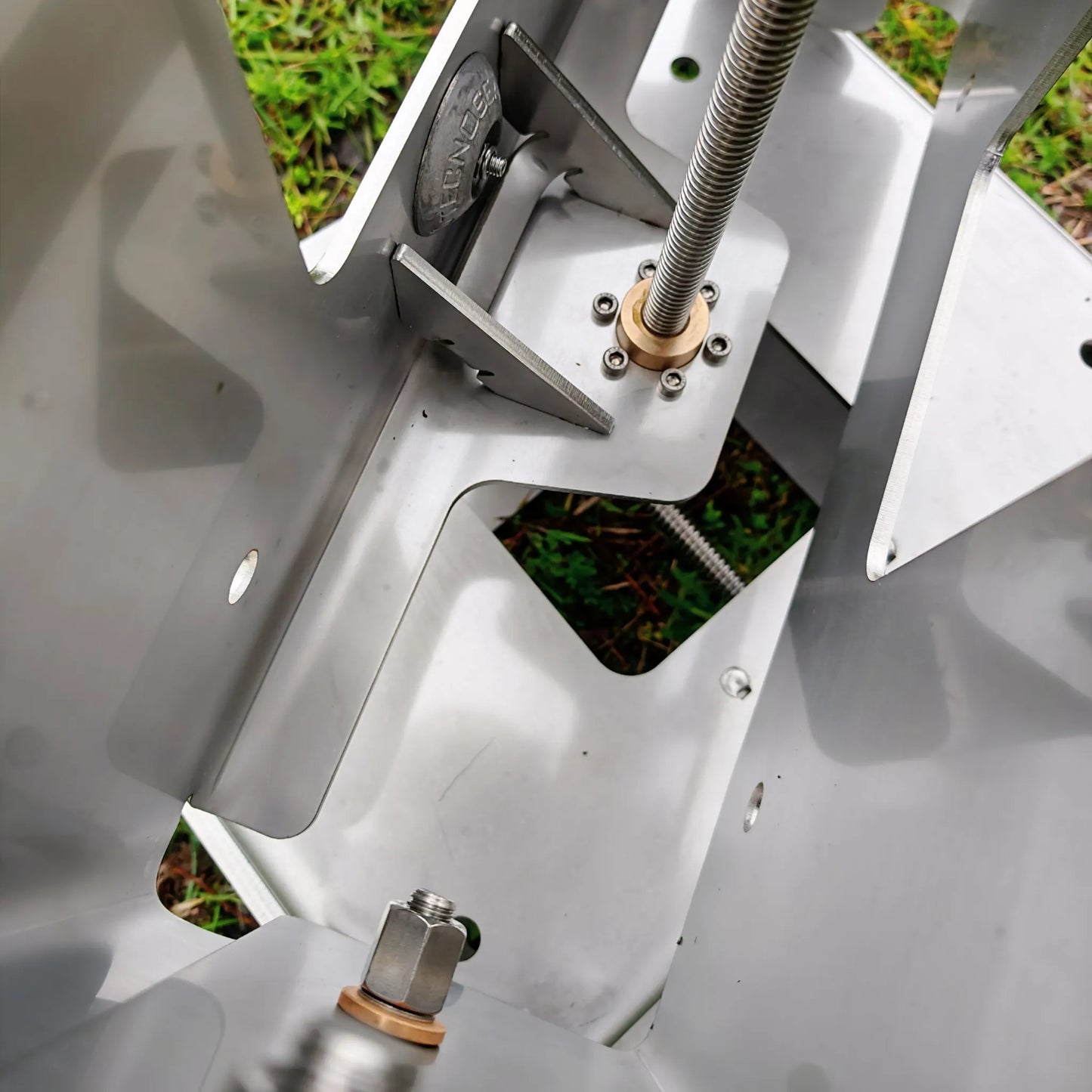
The main structure is manufactured from 5 mm AISI 304 stainless steel, with A4 stainless-steel clamping hardware, bronze bushings and a bronze adjustment nut. An AISI 316 version is available on request.
Solid stainless-steel construction Heavy-duty 5 mm stainless-steel plates form the main structural frame. Secure side clamping Four M12 A4-70 bolts secure the sliding assembly, with Schnorr safety washers and load-spreading washers. Bronze bearing components Bronze bushings and a bronze adjustment nut provide bearing surfaces between moving components. Replaceable anode protection A 50 mm sacrificial disc anode provides galvanic-corrosion protection. Choose zinc, aluminium or magnesium to suit your operating environment.Precise height control. Secure clamping.
The central TR14 trapezoidal screw raises or lowers the outboard. The four side bolts clamp the assembly securely once the height is set.
100 mm of adjustable travel, combined with 40 mm of static lift, provides 140 mm total lift. Reference markings at 10 mm intervals help you record and revisit tested engine positions.
- Support the engine and loosen the four side clamping bolts.
- Turn the central adjustment screw to raise or lower the outboard.
- Use the reference markings to record the engine position.
- Retighten the side clamping bolts to the torque specified in the Installation & Safety Manual.
- Water-test the setup and recheck the installation.
Never operate the height-adjustment screw while the side clamping bolts are fully tightened. Follow the Installation & Safety Manual for the complete support, adjustment and tightening procedure.
Technical specifications
AISI 316 version available on request
Frequently asked questions
What performance improvements can I expect?
A suitable setup can improve top speed, cruising efficiency and time to plane. The amount of improvement depends on your existing engine height, hull, propeller and load. There is no fixed speed, RPM or fuel-saving gain for every installation.
Will it make steering lighter?
Correct engine height can improve steering feel on some boats. Steering also depends on trim, propeller characteristics and the steering system. Raising the engine too far can reduce propeller grip and steering response.
Should I choose 100 mm or 150 mm setback?
The 100 mm (4") model keeps the engine closer to the transom. This 150 mm (6") model provides more setback, changing the engine's leverage and positioning the propeller farther aft.
Choose according to your hull, existing setback, engine weight and clearance requirements. More setback is not automatically better. Contact DonMarine with your boat and outboard model for help choosing.
How high should I mount my outboard?
There is no single correct height for every boat. Follow your outboard manufacturer's guidance and test progressively, maintaining reliable cooling-water supply, propeller grip and handling.
The highest position is not necessarily the best overall setting. An engine mounted too high can ventilate during acceleration or turns.
What engines can I use with this jackplate?
The jackplate is rated for outboards up to 200 HP and 250 kg. Both limits must be respected. Confirm transom suitability and steering clearance before installation.
Does it use the standard outboard bolt pattern?
Yes. The jackplate uses the standard BIA outboard mounting pattern. Confirm your engine's bolt pattern and the complete boat, engine and transom configuration before installation.
Can I change height with the engine installed?
Yes. Follow the engine-support and adjustment procedure in the Installation & Safety Manual. Loosen the four side clamping bolts before operating the TR14 adjustment screw, then retighten them as specified before use.
This is a manual jackplate. Height changes are made with the boat stationary, rather than while underway.
Which sacrificial anode should I choose?
Choose zinc for saltwater, magnesium for freshwater, or aluminium for brackish or saltwater use.
How should the sacrificial anode be maintained?
Inspect the anode at least every six months and replace it when it has been reduced to about 50% of its original size. Maintain direct metal-to-metal contact between the anode and jackplate.
Is an AISI 316 version available?
Yes. Contact DonMarine before ordering to discuss an AISI 316 stainless-steel version.
Bought the previous version and I can get on plane now! Shipped fast.

It seems to be of a very good standard and a very good workmanship!